01
Edge Log Analytics
Normalize request, cache, routing, timing, and policy fields into a model that answers operational questions.
Analyze the edgeCDNLog.com is a practical reference for edge log analytics, CDN monitoring, real-time log delivery, HTTP performance analysis, retention design, and security investigations—without vendor-specific guesswork.
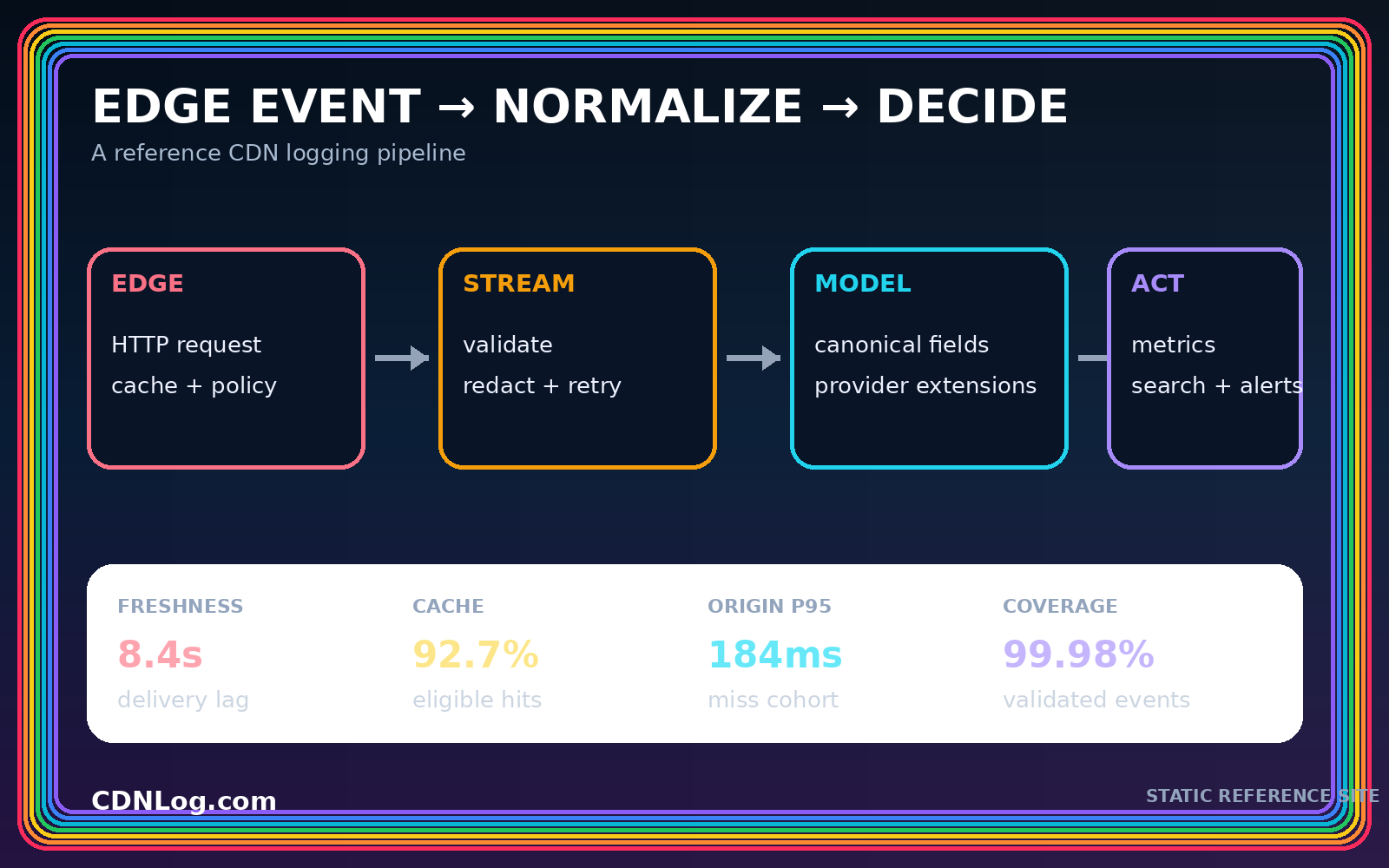
From event to decision
Use request-level evidence to understand performance, reliability, security, cost, and user-facing outcomes across the delivery path.
Normalize request, cache, routing, timing, and policy fields into a model that answers operational questions.
Analyze the edgeDerive stable metrics, SLIs, dashboards, and alerts without turning every high-cardinality event into a time series.
Build useful monitoringDesign ingestion, retries, redaction, schema evolution, backpressure, replay, and dual real-time/archive paths.
Design the pipelineSeparate cache, connection, first-byte, transfer, route, region, and origin effects to locate where time changed.
Trace latencyDetect material changes in behavior, correlate policy outcomes, protect sensitive fields, and control alert noise.
Investigate securelyBalance hot search, warm analytics, raw replay, long-term aggregates, deletion, access control, and total cost.
Plan retentionReference architecture
Keep the fast path small and actionable. Send the complete source to durable storage. Tie both to the same request identity, schema version, and data-quality signals.
Operational signal set
A strong dashboard separates user outcomes, delivery behavior, and data-pipeline health instead of mixing them into one generic traffic chart.
Field design
Start with a governed field contract that supports request tracing, HTTP analysis, cache decisions, origin performance, routing, and security context.
| Field family | What it explains | Core examples | Common mistake |
|---|---|---|---|
| Identity | Which request and schema produced the record | event time, observed time, request ID, provider, schema version | Using export time as event time |
| HTTP | What the client requested and received | method, host, route, status, protocol, bytes | Indexing raw query strings by default |
| Cache | Why the edge did or did not contact origin | hit, miss, bypass, revalidated, age, TTL, key version | Combining every non-hit outcome |
| Timing | Where time entered the delivery path | connect, first byte, origin, transfer, total edge duration | Comparing different timing boundaries |
| Policy | Which control acted and how | action, rule ID, rate limit, bot signal, result source | Treating a score as a verdict |
| Pipeline health | Whether the observability data is trustworthy | delivery lag, duplicates, parse failures, coverage | Alerting on service data while logs are incomplete |
Edge Signal Journal
Deep, implementation-focused articles for platform engineers, SRE teams, security analysts, and developers working with CDN request data.

Convert request-level CDN logs into stable service indicators, error-budget alerts, and incident context without paging on noisy raw events or high-cardinality dimensions.
Read the guide
Create comparable multi-CDN metrics without erasing provider differences by using a canonical schema, capability metadata, explicit cache semantics, and rigorous data-quality checks.
Read the guide
A practical workflow for separating edge, network, origin-connect, time-to-first-byte, and transfer delays using CDN log fields and matched request cohorts.
Read the guideFrequently asked
Clear answers to the questions that shape schemas, pipelines, monitoring, and investigations.
CDN logging records request and response activity at edge locations, including HTTP outcomes, cache decisions, routing, timing, bytes, and optional security signals.
Origin logs see only traffic that reaches the origin. CDN logs can also describe cache hits, edge-generated responses, blocked requests, edge functions, and regional delivery behavior.
Usually not. Real-time streams are useful for monitoring and fast response, while batch exports provide efficient retention, replay, and historical analysis. Many teams use both.
A strong starter schema covers event time, request ID, host, normalized route, status, cache outcome, edge location, origin identity, bytes, timing, provider, and schema version.
Yes, when they include controlled policy, network, route, and outcome context. Sensitive values should be minimized, redacted, access-controlled, and retained only for an approved purpose.
No. CDNLog.com is an independent technical reference site focused on architecture, field design, monitoring, and analysis patterns for CDN and edge logs.
Start with the developer reference, then connect fields to dashboards, investigations, and SLOs.